Home
Our Tree Service
ISA Arborist
Pruning a tree
Tree Removal
Stump Removal
Hiring a Service
Do It Yourself
Contact Us
Tree Problems
Resources
STORM CLEANUP
Firewood Sales
Damaged Trees
Testimonials
 

Planting Tree with a Ball and Burlap (B & B)

The instructions below can be adapted for planting trees of all types. We're planting nursery trees that come Balled in Burlap, or Balled and Burlapped, (and you'll see various spellings including the term B & B). Obviously they all mean the same: You have young tree with a root ball surrounded by a ball of dirt, a piece of burlap, and usually a wire cage, and there is some sting involved in keeping it together. Many ask about removal of the cage--yes, all wire, strings, burlap is removed. Please read on for details.

Are you planting a tree with bare roots?

Once you have found the ideal location for your tree, grab your tree planting tools:
• Shovel
• Gloves
• Wire cutters to cut the wire basket
• Hand pruners to cut select crossing roots
• Knife or garden scissors to cut burlap and strings
• A hand tool such as a spading fork to break up soil
• A helper—if the tree is heavy or tall
• Soil amendments if necessary, a root boosting product
• A tarp or bucket for the excess soil
how to plant tree
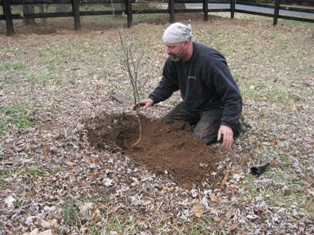
When digging your hole, make sure that it is plenty wide to accommodate future tiny feeder roots that will grow quickly and fill the planting area. The hole should not be deep. I suggest making the hole about two-thirds as deep as the ball on the tree. Store the soil nearby for later; a bucket or tarp will make for easy clean up. I prefer a tarp, as I can sort the soil and later use the most loamy parts. If you are spending the afternoon planting trees, a wheelbarrow will serve you well!
Planting depth
See how this tree appears to be sticking out of the ground too much? When complete, the tree will settle down to a perfect level. You'll see! Most people and landscapers plant trees too deeply!

A note on the clay in some areas of the country: when using a shovel against clay, the cutting and subsequent smearing of soil by the shovel creates a glazed surface which can act as a water barrier, and a impenetrable underground wall to roots. To increase the permeability of the new hole, break up the sides of the hole with a spading fork, hand cultivator, or the tip of the shovel. This simple step will decrease the chance of the tree drowning in a stagnant pool of water, give the roots plenty of room, and prevent roots from doubling back around and girdling each other or the trunk.

If your soil is very clay or rocky, you may want to dig a larger hole and add a high quality compost based soil builder. You will use this also to mix in with the soil that is returned to the planting hole.
Remove burlap when planting
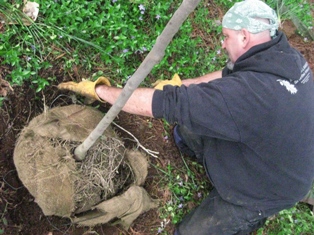
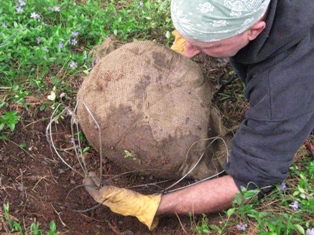
Once you get the tree in the shallow hole, begin to remove the cage and burlap. Remove all of the human trappings—cage, burlap, rope, string, tag, plastic thingys, wires, and anything else you see! If the tree was heavy or tall, you might want some help getting the burlap out from underneath. Take great care through all of this; you don’t want to damage any of the roots—a B & B tree has already lost a significant amount of roots and what remain are critical to survival! Protect the trunk as well when you are moving the tree around.
Plant tree, burlap ball
Tilt the tree one way and cut the wire. Then the other way and reach up under and cut all of the wire and twine.
Remove burlap
Remove all of the wires and strings. Do not omit this step!
Remove burlap when planting tree
Completely remove the burlap. Contrary to popular advice, the burlap does not degrade in the next few years after planting the tree. If left in place, it will lead to girdling roots, inhibit the tree from stabilizing itself, and eventually may lead to the tree dying after being stunted. Do not omit this step either!
planting tree
Take time to talk to the tree and find out if it has any specific instructions. You’ll be amazed at what you’ll understand!
tree planting, roots
Your B &B tree may actually have too much soil around the trunk, so take time now to carefully remove some of the soil to check the condition of the roots. You may discover some major issues that you can correct during planting to insure the tree’s survival.

Roots may appear crossing or tangled from being in a ball. Separate every root that you can see and try to give it s own little space. Don’t bend or break the roots, but some may just come free when the soil has been loosened.
tree planting guide, redbud
I've even found a string left over from a previous transplanting. This could get trapped between the roots and cause decay or girdling as the root flare expands.
plant tree
I have found some roots that are growing back towards the trunk that will become girdling roots. (This is not a very good picture to show what I am talking about.) I will cut one or two away to prevent this. I know that I am taking more roots away, but I am now doing “corrective surgery.” Continue being gentle so you don’t loose any other roots.

Here I see some terribly crossing roots—looks like a serious problem, but I have already made the amount of pruning cuts that I think this little tree can handle. This problem is too involved and the tree is going to have to overcome it by itself. Sorry to say, this is what you get with balled and burlapped trees, and it’s hard to know ahead of time. We will be optimistic and plant this tree correctly to give it every possible advantage.

Carefully begin to hand pack some soil around the roots, but not too hard.

You can see where the soil line used to be when in the B & B. Way too high! Planted in the ground at this level, the feeder roots would be too deep, and the trunk bark would decay and become susceptible to fungus and insects.

Gently pack a little more soil in around the roots with your hands. Don't use a shovel or your foot. You will likely damage the small roots and root hairs.

I'm a little frustrated with these roots that are braided. They are sticking up above the soil line that is healthy for the trunk. I will leave them with a dusting of soil.

The tree you purchase may also have some challenges and you will have to figure out the best solution. The proper depth for the overall tree is most important. It is better for the roots to grow away and down than for them to climb up through the soil.
Tree planting guide
There is a significant volume of soil left over. Do not add this around the tree, it will only suffocate the small feeder roots. Use it in another location or add it to your compost pile.
planting tree
Water your young tree. Here I have added a root boosting formula with kelp to supply the roots with nutrients.

Keep your newly planted tree watered, but not drowned(!) over the first spring-summer-fall season. Allow it to dry out in between waterings or rain showers, but don't let the soil get bone dry. Great job!

Back to the Tree Planting Guide
Done with Planting Tree, Back to home page arborist-treecare.com


footer for Planting Tree page